Pages

Welcome to SergioS's Math Analysis Blog

Welcome to SergioS's Math Analysis Blog

Thursday, March 6, 2014

WPP #12: Unit O Concept 10 - Solving Angle of Elevation and Depression Word Problem

Mark is spending a glorious weekend away from school, and is indulging in music. At a local venue, Mark's band was invited to play with multiple other local bands. When they arrive at the venue, Mark can't help but realize that the building is quite tall. 
A) If Mark is standing 10 feet away from the building, how tall is the building itself if the angle of elevation is 50 degrees?
B) Mark is now standing on top of the building. He looks across the street, and sees that the restaurant across the street has tables outside. In the starry night, his gaze is captured by a rather extremely attractive girl who appears to be his age and is sitting the equivalent of 30 feet away from him if he were to zip line over to her. Being the geek he is, the first thing that comes to Mark's mind is "How far away might this lady be?" (angle of depression is 40 degrees)


The Solution


Tuesday, March 4, 2014

I/D2: Unit O - How can we derive the patterns for our special right triangles?

Inquiry Activity Summary

1) 30-60-90 Triangle

In order to derive the 30-60-90 from an equilateral triangle whose sides all equal 1 (in this case), we start out by cutting it straight down the middle (vertically) in a way that the triangle becomes two identical triangles. Original, the triangle is made up of all 60 degree angles. By cutting it in half, the top angle become 30 degrees, and either the right or left angle (depending on which one you use) is the 60 degree angle, thus giving you the 30-60-90 Triangle.


In the last three pictures, you can see the way that the 30-60-90 triangle is formed. We know that each leg should be equal to 1, but we have one side that has to values of 1/2 when it is split. This is simply to show that when we split the triangle down the middle, you end up with 2 separate 30-60-90 triangles with legs being equal to 1, 1/2, and the b leg is equal to radical 3/2. The way you find the value of leg b is shown in the next picture.


Here, we have the Pythagorean Theorem. As you can see, we have 1/2 to the second power. This gives us 1/4, which we subtract from 1 on the other side. we are left with radical 3/4 which then simplifies to radical 3 divided by 2. 


Here, we have the 30-60-90 triangle, but we have placed "n" in each value to show that there is a proportion in the triangle. The values of each leg form a ratio, which remains the same regardless of what value you use for n. Since you multiply fairly, you multiply the same amount for "n", thus ending up with the same ratio you started with.

2) 45-45-90 triangle

In order to obtain this triangle from a square, we have to cut the square diagonally. Since we start out with a square, all sides are equal to 1 (the given value), and we simply need to find the value of the hypotenuse.


In these two last pictures, we see the transformation from the square to the triangle. Using what we know of the 45-45-90 triangle, we know that by cutting the square diagonally, your 90 degree angles in two of the corners will split in half to give you the 45 degree angles that we need. Then, we know that the legs directly opposite to the 45 degree angles are "n", which means that n=1 (since legs=1). We know that the leg opposite to the 90 degree angle is n radical 2, which means that the hypotenuse is radical 2.


This picture goes over the way to get the hypotenuse using Pythagorean Theorem. You get the same answer, but have a couple extra steps.


This picture shows the original square, with substituted into the values. Like stated in the 30-60-90, we use the letter "n" to show the ratio between all the legs, and just like in the 30-60-90 triangle, this ratio is the same regardless of what value you substitute for "n".

Inquiry Activity Reflection
Something I never noticed before about special right triangles is that you can derive them from either a square or a triangle of same values.
Being able to derive these patterns myself aids in my learning because I can quickly derive the Special Right Triangles during a test if I forget all else, and possibly pass the test.

Sunday, February 23, 2014

I/D1: Unit N - How do SRT and UC relate?

Inquiry Activity Summary:
The activity we did in class basically used our knowledge of geometry to derive the Unit circle from Special Right Triangles of 30, 45, and 60 degrees. We basically had to set our hypotenuse equal to zero. Then, we had to do the same to the other two legs (simplifying the triangle legs fairly). Then, we labeled the triangle with the hypotenuse being r, the vertical leg being y, and the horizontal leg being x, and then placed the triangles in a coordinate plane with the the origin located at the angle measured ( to get the triangle in Quadrant 1. Finally, we labeled the vertices and found the ordered pairs.

1)

http://upload.wikimedia.org/wikipedia/commons/1/15/Triangle_30-60-90_rotated.png
This triangle above is the 30 degree special right triangle. The leg opposite to 30° is the y value (vertical), the leg opposite to 60° is the horizontal value (horizontal), and the leg opposite to the 90° angle is the r value (hypotenuse). In order to find our ordered pairs, we had to set the hypotenuse equal to 1. In other words, we had to divide by 2x. If you divide 2x from the hypotenuse, then you need to divide all of them by 2x. When you do this you are left with x=√3∕2, y=1∕2, and r=1. The ordered pair is (√3∕2 , 1∕2)

2)
http://mathcountsnotes.blogspot.com/2012/05/special-right-triangles-30-60-90-and-45.html
The triangle above is the 45° special right triangle. The leg opposite to the lower 45° angle is the y value (vertically), the leg opposite to the higher 45° angle is the x value (horizontal), and the leg opposite to the 90° angle is the r value (hypotenuse). Once again, we need the hypotenuse to be equal to 1, so we need to divide by √2x. When we do this all legs, the all the Xs cancel out, but you are left with radicals on the bottom so you need to rationalize. In order to do this, you multiply √2 to both the top and the bottom. When you multiply the bottom, the radicals cancel out, and you are left with √2∕2. This means that the values end up being x=√2∕2, y=√2∕2, and r=1. The ordered pair is (√2∕2 , √2∕2)

3)
http://mathcountsnotes.blogspot.com/2012/05/special-right-triangles-30-60-90-and-45.html
This triangle above is the 60 degree special right triangle. The leg opposite to 60° is the y value (vertical), the leg opposite to 30° is the horizontal value (horizontal), and the leg opposite to the 90° angle is the r value (hypotenuse). In order to find our ordered pairs, we had to set the hypotenuse equal to 1. In other words, we had to divide by 2x. If you divide 2x from the hypotenuse, then you need to divide all of them by 2x. When you do this you are left with x=1∕2, y=√3∕2, and r=1. The ordered pair is (1∕2, √3∕2)

4) This activity helps us derive the unit circle because these are basically the three triangles found in the unit circle. All that you need to do is move the triangles around into the other quadrants in order to find the rest of the unit circle.

5) All the triangles in this activity lie in Quadrant I. If we were to transfer the triangles into the other Quadrants, only the signs of either the X or Y values would change. In other words, instead of having a positive X, you would have a negative X, and so on.

http://01.edu-cdn.com/files/static/learningexpressllc/9781576855966/The_Unit_Circle_45.gif

In this triangle we see that the ordered pair has remained almost the same for the 45° angle. The only thing that has changed is that the ordered pair is no longer (x , y) but rather (-x , y) due to being located in Quadrant II.
http://01.edu-cdn.com/files/static/learningexpressllc/9781576855966/The_Unit_Circle_34.gif

In this triangle we see that the ordered pair has once again changed slightly from original form for the 30° angle. Instead of having an ordered pair whose signs are (x , y), we have and ordered pair whose signs are now (-x , -y) due to being in located in Quadrant III.

http://02.edu-cdn.com/files/static/learningexpressllc/9781576855966/The_Unit_Circle_21.gif

In this triangle we see that the ordered pair has (like in the last two) changed slightly for the 60° angle. instead of having the ordered pair of (x , y), we have the ordered pair being (x, -y) due to now being located in Quadrant IV.


Inquiry Activity Reflection:
1) The coolest thing I learned from this activity was the Special Right Triangles. I personally do not remember learning this or the Unit Circle in my past two years of taking math.
2) This activity will help me in this unit because I can draw out the triangles in Quadrant I, label the ordered pairs, and write out the "ALL STUDENTS TAKE CALCULUS" and I'll have the whole Unit circle.
3) Something I never realized before about Special Right Triangles and the Unit Circle was that they existed.

WORK CITED:
http://upload.wikimedia.org/wikipedia/commons/1/15/Triangle_30-60-90_rotated.png
http://mathcountsnotes.blogspot.com/2012/05/special-right-triangles-30-60-90-and-45.html
http://01.edu-cdn.com/files/static/learningexpressllc/9781576855966/The_Unit_Circle_45.gif
http://01.edu-cdn.com/files/static/learningexpressllc/9781576855966/The_Unit_Circle_34.gif
http://02.edu-cdn.com/files/static/learningexpressllc/9781576855966/The_Unit_Circle_21.gif

Tuesday, February 11, 2014

Real Wold Application - Ellipses

Ellipse

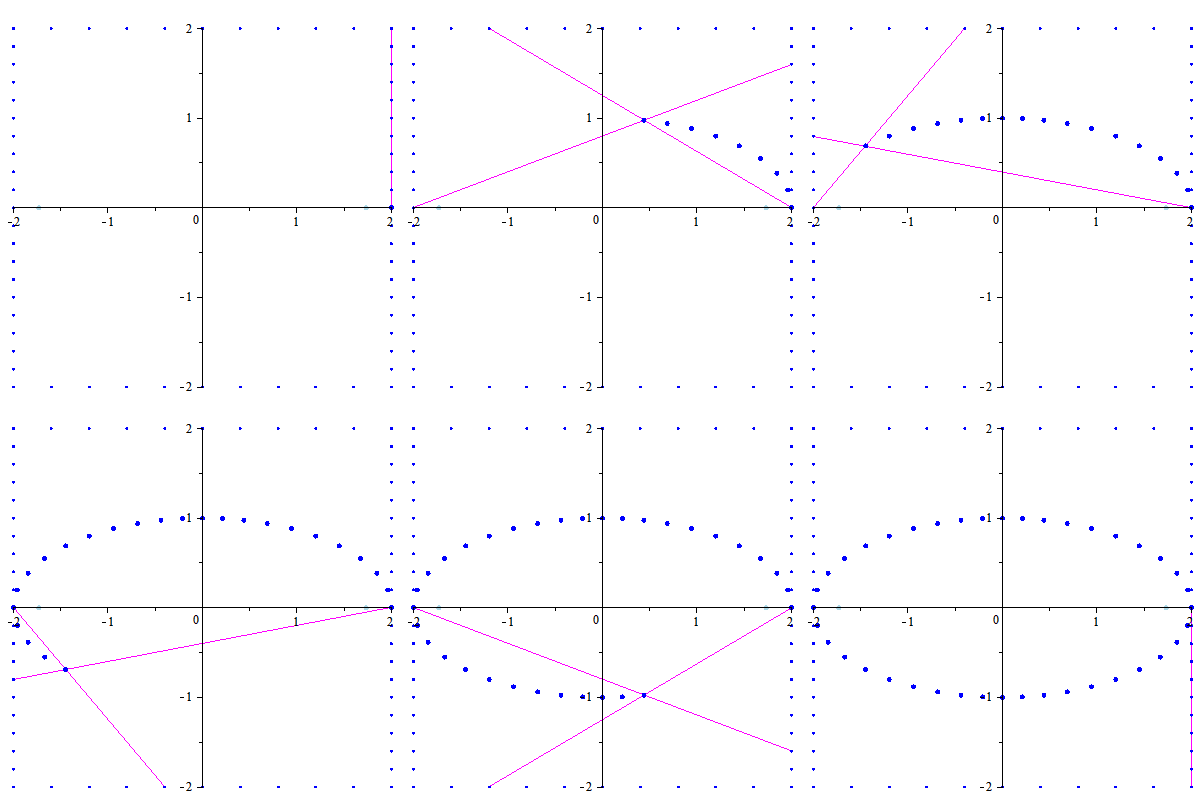
1)Definition: an ellipse is the set of all points such that the sum of the distances to two fixed points (known as the foci) is constant.


2)Algebraically, an ellipse's equation looks like (x-h/a)^2 + (y-k/b)^2 = 1 or (y-k/b)^2 + (x-h/a)^2 = 1. You have to keep in mind that both terms are squared, and x always goes over a and goes with h, while y goes over b and goes with k.
Here you can see the ellipse being drawn out


http://upload.wikimedia.org/wikipedia/commons/6/6a/Ellipse_construction_-_parallelogram_method.gif


3)Graphically: the ellipse is similar to an oval. It is egg shaped, and consists of 2 vertices, 2 co-vertices, 2 foci, 1 major axis, and 1 minor axis.Here, you can see these aspects


http://www.mathsisfun.com/geometry/ellipse.html

Real World Application: Ellipses can be found everywhere we look. From a glass of water to the way that planet and other things orbit in space, you can find an ellipse.

http://britton.disted.camosun.bc.ca/jbconics.htm

If you wish to learn more about ellipses and what make them up, you can click the link below

https://www.khanacademy.org/math/algebra/conic-sections/conic_ellipses/v/conic-sections--intro-to-ellipses

Work cited:

http://upload.wikimedia.org/wikipedia/commons/6/6a/Ellipse_construction_-_parallelogram_method.gif

Monday, December 9, 2013

SP#6 Unit K Concept 9 - Finding Sums of Finite Geometric Series


          Something that the viewers should be careful with, is finding the "r". It is also important to be careful when getting rid of the denominator by multiplying its inverse. When dividing both the numerator and denominator by 3, all we do is simplify it. It's not extremely necessary, but it just makes the numbers smaller. When adding the 2, you multiply 333 to both the top and the bottom, and then you leave it as a fraction.